The Oura Ring and T1D
This blog was originally published as an email newsletter sent on April 13, 2026
Back in November (thanks to a Black Friday sale), I finally pulled the trigger and bought an Oura Ring!
I was SO hesitant to buy one because I’m not someone who goes for all the latest “gadgets”. I thought it would be something I spend money on but don’t actually get much out of. But a few of my friends were big fans, and my Apple Watch is old and getting glitchy, so I gave it a try!
After five months, the one question I get asked pretty often is whether it helps with T1D…
My answer? Not directly.
Like having the Dexcom app on my Apple Watch made a big impact on my blood sugars. I could more conveniently see my graphs for more proactive correcting.
But while the Oura ring hasn’t offered that level of direct impact, it has given me some interesting data and insights to better understand my blood sugars.
Especially when it comes to sleep, activity, and my cycle, it has helped explain why my blood sugars might be acting the way they are. And therefore it’s helped me make better diabetes and health decisions !
And I will say— there’s not much on the Oura ring that I can’t get from other (often free) apps, but having it conveniently on my finger all the time helps make that data more accurate. (In each category below, I’ve added the free options if you want similar data without the Oura ring!)
Here are 3 ways I’ve used my Oura Ring to better understand my blood sugars.
1. Sleep
One of the biggest reasons I wanted the Oura Ring was to track my sleep. (I never wore my Apple Watch to bed because it needed to charge overnight, so I really wasn’t getting a clear picture of how well I was actually sleeping.) With the Oura ring, the battery lasts long enough that I don’t have to charge it overnight, so I can actually wear it while I sleep consistently!
By tracking my sleep, I could make changes to help me get better sleep.
And sleep can have a big impact on blood sugars the next day. Poor sleep can make blood sugars more resistant, increase cravings, and create a ripple effect into a lot of other health decisions. When you’re tired, you’re usually less likely to carefully count carbs, think through a bolus, and make good decisions (hello rage-bolusing). So while sleep matters for everyone, it can make a huge impact when you’re managing T1D.
(Free option: Sleep Cycle or Sleep Tracker, and Apple Health has one that connects with watch! )
2. Step count
I don’t think a step count is something to obsess over, BUT it can make a big difference in blood sugars to get consistent steps.
Take two weeks ago, for example: my step count TANKED because of the pollen and my inability to leave my house without sneezing. I was around 3k steps per day.
Last week? I made an effort to walk more on the treadmill and hit at least 6k steps per day. My time in range increased by 8% 😳. (Could other things have impacted this? Of course! But that was the change that I made and the result I saw!)
More blood flow, more muscle engagement throughout the day = better insulin sensitivity and more predictable sugs! Think less sticky highs!
Having the step count linked to my Oura ring means that I have a lot more accurate count— I don’t always have on my watch/have my phone so sometimes that count is very off!
(Free option: Apple Health, Step Counter )
3. Understanding my cycle
This has been one of the coolest features for me.
The ring tracks temperature, which gives a more precise look at where I am in my cycle. When my temperature starts rising, that helps indicate I’m moving into the luteal phase.
And insulin resistance often increases during the luteal phase, so that gives me a better idea of when I might start noticing I need more insulin!
Another part of the cycle that can really impact blood sugars is ovulation. The Oura Ring helps me more clearly see when ovulation is happening because I can see that shift from below baseline to above baseline temperature.
So again, it’s not directly changing anything. But it is giving me more context, which helps me make better decisions and understand what’s happening!
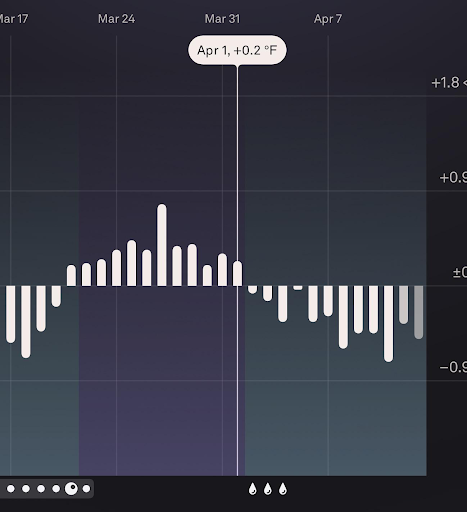
Below you can see my temp slightly lower during my follicular phase (the grey-ish color), then rise after ovulation during my luteal phase (the purple-ish color). Luteal phase is often where I experience more insulin resistance.
4. Readiness score
The Oura Ring gives you something called a readiness score.
This score takes into account things like resting heart rate, sleep patterns, and what Oura calls resilience.
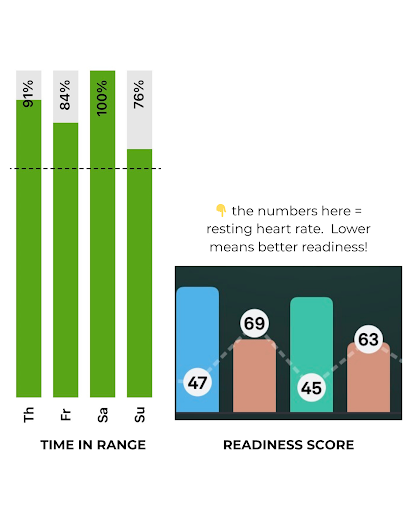
About a month ago, I had a travel day that included a red-eye flight, and I noticed that my readiness score lined up really closely with how my blood sugars behaved during my short trip to Barcelona. And since then, I've noticed the pattern of readiness score, and my TIR is actually quite connected!
You can see below that on the day where my readiness score was higher (lower resting heart rate), my TIR was 90%+), but when my resting heart rate was higher, my TIR was lower. It was a really interesting correlation to see!
Now, if I wake up and see that my readiness score is low, I know I may want to be a little more intentional with my diabetes decisions that day.
Maybe that means choosing foods that feel easier to bolus for.
Maybe that means prioritizing rest and recovery where I can instead of pushing through.
So while I resisted getting the Oura ring for a long time-- I like to keep my diabetes and health as SIMPLE as possible-- I have to admit, it has added a lot of insight to my blood sugars! And I've made goals around my step count, sleep patterns, cycle, and recovery that have likely impacted the predictability of my blood sugars. It helps me see HOLISTIC data around my health, which gives so much context to my blood sugars!
And if you want support to create holistic changes around your T1D management, PLUS:
a framework for more in-range blood sugars
actionable steps to meet your T1D goals
support from a powerful community on the same journey
and most importantly, someone to lead the way....
CONFIDENCE & CONTROL is a 12-week group program where you get just that!!
Learn more about the program here!
